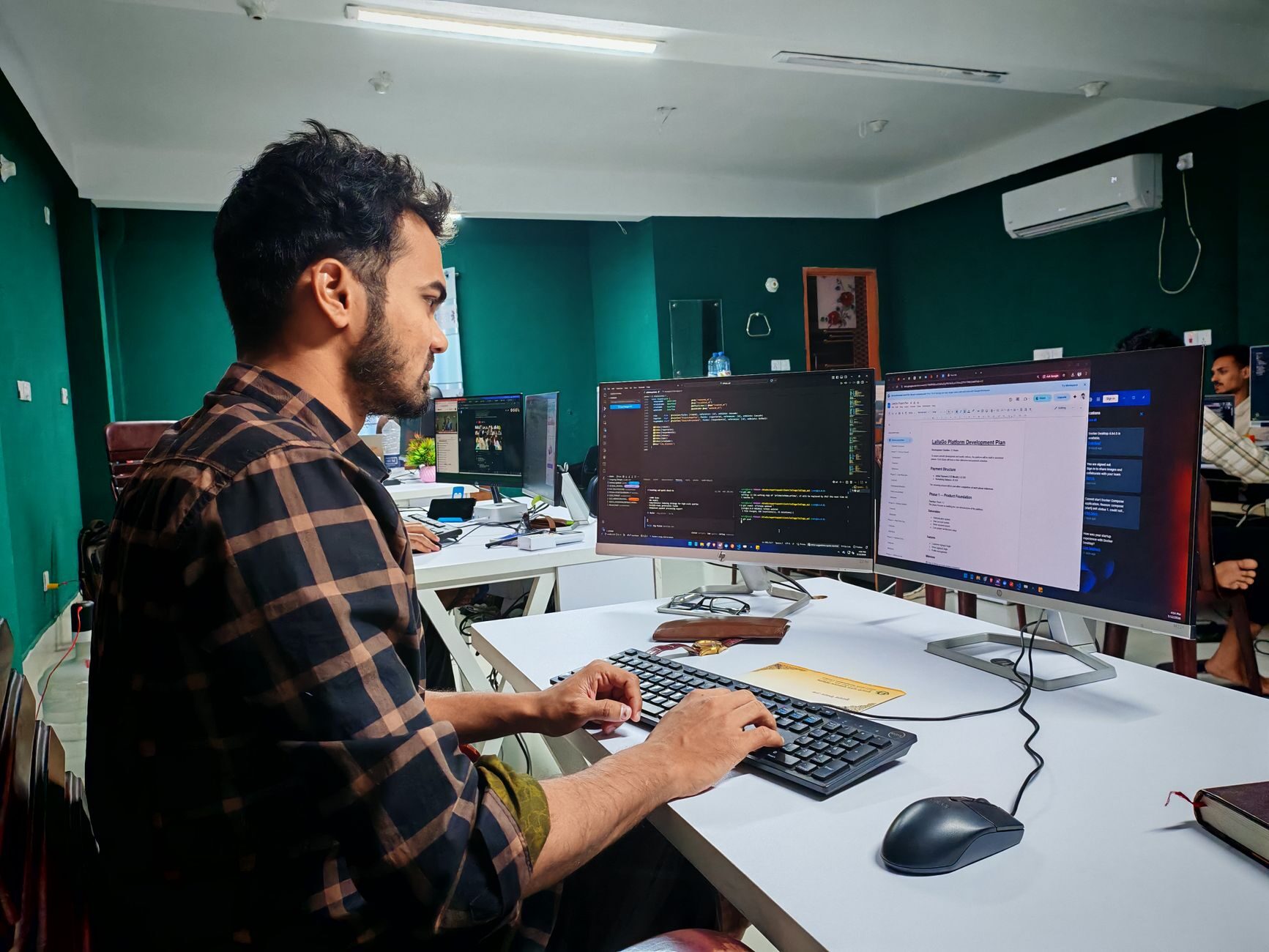
Custom business software is an application built specifically for one organization’s workflows, data, and rules — rather than a one-size-fits-all product you license off the shelf. A typical custom build runs $15,000 to $150,000+ and takes 3 to 9 months, depending on complexity. You choose it when your processes don’t fit existing tools, when per-seat SaaS fees balloon as you grow, or when you need systems to talk to each other that otherwise can’t.
This guide answers the questions buyers actually ask before commissioning a build: what it costs, how long it takes, when off-the-shelf is the smarter call, and how to pick a developer who won’t leave you stranded.
What is custom business software, exactly?
Custom business software is a program designed and coded around your specific operations instead of adapted from a generic template. Where a platform like Salesforce or QuickBooks gives every customer the same core product with configuration options, a custom application starts from your workflow and builds outward.
The main types
- Internal tools — dashboards, inventory systems, scheduling apps, and approval workflows used by your team.
- Customer-facing portals — booking systems, member areas, quote builders, or account portals your clients log into.
- Integrations — middleware that connects your CRM, accounting, and fulfillment tools so data flows automatically.
- Data and reporting systems — custom analytics that pull from several sources into one view.
The defining trait is ownership of logic: the software does exactly what your business does, including the odd rules competitors’ off-the-shelf tools can’t accommodate. According to IBM’s overview of custom software, the value lies in solving a problem no commercial product addresses precisely. That precision is the whole point — and also the reason it costs more than a monthly subscription.
How much does custom business software cost?
Custom business software typically costs $15,000 to $150,000+, and the range is that wide because “custom” covers everything from a single automated form to a multi-user platform.
Typical price bands
- $15,000–$40,000 — a focused internal tool: one workflow, a handful of users, basic reporting.
- $40,000–$90,000 — a multi-feature application with user roles, a customer portal, and third-party integrations.
- $90,000–$150,000+ — a platform-grade system with complex logic, real-time data, and ongoing scale requirements.
Beyond the build, budget 15–20% of the project cost per year for maintenance, hosting, security patches, and small enhancements. Software is not a one-time purchase; it’s an asset that needs upkeep like any other. Forrester’s research on total cost of ownership consistently shows that maintenance and support outweigh the initial build over a product’s lifetime. Ask any prospective developer for a line-item estimate that separates design, development, testing, and ongoing support — a vague lump sum almost always hides surprises.
How long does it take to build?
Most custom business software takes 3 to 9 months from kickoff to launch, with simpler internal tools shipping in 6–10 weeks and enterprise platforms running a year or more.
A realistic timeline
1. Discovery (2–4 weeks) — mapping your workflows, defining scope, and writing requirements.
2. Design (2–4 weeks) — wireframes, data models, and user-flow approval before any code is written.
3. Development (8–20 weeks) — built in iterative sprints so you see working pieces along the way.
4. Testing (2–4 weeks) — quality assurance, bug fixing, and user acceptance testing.
5. Launch and training (1–2 weeks) — deployment, data migration, and team onboarding.
The biggest timeline risk isn’t coding speed — it’s indecision. Projects stall when requirements keep shifting or feedback is slow. A good developer builds in checkpoints and ships a usable minimum version early so you get value before every feature is finished.
When should you buy off-the-shelf instead?
Honestly, most businesses should try off-the-shelf first. If a $50/month SaaS product covers 90% of what you need, buying custom business software to save that monthly fee rarely pays off.
Buy off-the-shelf when:
- A proven product already fits your workflow closely.
- Your process is standard and unlikely to change.
- You need something running next week, not next quarter.
Build custom when:
- You’re paying for ten tools that don’t talk to each other.
- Per-seat SaaS costs are climbing faster than the value you get.
- Your competitive edge depends on a process no vendor supports.
- Manual data entry between systems is eating real staff hours.
A useful test: add up what your team spends in wasted hours and redundant subscriptions over three years. If that number dwarfs a custom build, the math favors building. If not, keep your off-the-shelf stack and spend the budget elsewhere. A trustworthy developer will tell you when you don’t need them.
Why do big platforms dominate the “custom software” conversation?
When people search for who creates custom business software, enterprise platforms like Salesforce surface first because they spend enormous marketing budgets and serve Fortune 500 clients. But those platforms sell configurable products, not truly bespoke software — and their minimum engagements price out most small and mid-sized businesses.
What a smaller specialist does better
- Direct access. You talk to the people writing the code, not a tiered support queue.
- Right-sized scope. A $25,000 tool is a real project, not an account too small to prioritize.
- No forced ecosystem. You own the software outright instead of renting seats forever and getting locked into one vendor’s platform.
- Local accountability. A developer you can meet is a developer who answers for the result.
The gap large platforms leave is the business that needs genuinely custom logic but isn’t buying a six-figure enterprise license. That’s exactly where a focused development partner fits — delivering bespoke software without the platform tax or the lock-in.
What technology should your custom software be built on?
The right stack depends on what the software does, but most modern custom business software is built on well-supported, open frameworks so you’re never dependent on a single proprietary vendor.
Common, dependable choices
- Web applications — React or Vue on the front end, with Node.js, Python/Django, or PHP/Laravel on the back end.
- Business sites and portals — WordPress with custom plugins when the tool wraps around content, membership, or publishing.
- Databases — PostgreSQL or MySQL for structured business data.
- Hosting — managed cloud infrastructure with automated backups and security monitoring.
Avoid any developer who builds on a closed, proprietary system you can’t move away from — that’s lock-in by design. The OWASP Foundation publishes the security standards your build should follow regardless of stack. Ask prospective developers how they handle updates, backups, and vulnerabilities after launch; secure, maintainable code matters far more than which trendy framework they prefer.
How do you choose a custom software developer?
Choose a developer the way you’d hire a contractor to build an addition: check the work, confirm who owns the result, and make sure they’ll be around after handoff.
Questions to ask every candidate
- Who owns the code? The answer must be you — source code, accounts, and documentation included.
- What happens after launch? Confirm maintenance, hosting, and support terms in writing.
- Can I see comparable work? Ask for examples at your size and in your situation.
- How do you handle scope changes? A clear change process prevents budget blowups.
- How is my data secured and backed up? Vague answers are a red flag.
For businesses in Louisiana, a regional partner keeps communication simple and accountability real. Eight Hats builds custom business software and web applications for small and mid-sized businesses from Lafayette, LA, and you can discuss a project directly through the Eight Hats team. Whoever you choose, get the ownership terms and support plan in writing before work begins.
What ongoing costs should you plan for after launch?
Plan for 15–20% of the build cost annually to keep custom business software secure, updated, and running — software is a living asset, not a finished product.
Recurring costs to budget
- Hosting and infrastructure — managed servers with monitoring, often $20–$300+/month by scale.
- Security and updates — patching frameworks and dependencies as vulnerabilities emerge.
- Backups and disaster recovery — automated, tested backups you can actually restore from.
- Enhancements — small feature additions as your business evolves.
The mistake that sinks projects is treating launch as the finish line. Unmaintained software accumulates security risk and breaks as browsers, integrations, and operating systems change around it. Factor these costs into your decision from the start, not as an afterthought. A reputable developer will present ongoing costs upfront rather than surprising you a year later — and if they don’t offer a support plan at all, ask who will keep the system healthy once they walk away.